
Introduction
Key takeaways
Key takeaways
- WS2811 is an external LED driver IC, while WS2812 and WS2812B integrate the driver and RGB LEDs in a single 5050 package.
- WS2811, WS2812 and WS2812B are all RGB, 8-bit per channel and 24 bits per pixel, using a single data wire at 800 kbps with no clock and no backup data line.
- WS2812B is a WS2812 with a four-pad package instead of six pads, plus reverse-power protection.
- WS2812 and WS2812B are control-compatible, but a WS2812B is not automatically a direct PCB replacement for a six-pad WS2812.
- WS2811, WS2812 and WS2812B are not RGBW. WS2814 and WS2815B are RGBW options supported by .
- WS2811, WS2812 and WS2812B are all supported across the PixLite® Mk3 family.
Who this guide is for
Who this guide is for
This guide is for anyone specifying, designing or installing addressable pixel lighting who needs to choose between WS2811, WS2812 and WS2812B, or who has been supplied one of them and wants to know what that means for the rest of the system.
- and comparing pixel types for a new project.
- Installers and planning wiring, power and controller placement.
- Fixture manufacturers deciding between an external driver IC and an integrated LED package.
- PixLite® users who want to confirm compatibility and choose the right protocol setting.
What you will learn
What you will learn
- How WS2811, WS2812 and WS2812B differ in architecture, package and power requirements.
- What actually changed between WS2812 and WS2812B, and whether the two are compatible.
- Why none of the three is RGBW, and which protocols to consider if you need a white channel.
- How Data-Only pixels compare with backup-data and clocked pixels.
- How pixel count affects frame rate, and where 8-bit resolution becomes a limitation.
- How to choose a PixLite® Mk3 controller for these pixels, including options.
Which one should you choose?
Which one should you choose?
- Choose WS2811 when the fixture needs flexibility over the LEDs, their physical placement, or a higher-voltage power architecture such as 12 V or 24 V.
- Choose WS2812B when the priority is a compact, integrated RGB pixel.
- Choose WS2812B over the original WS2812 for its simpler four-pad construction and reverse-power protection.
- Consider a newer pixel protocol when the installation needs RGBW, higher color resolution, a higher PWM rate, backup data or faster data transfer.
Differences
, and WS2812B are some of the most recognisable names in addressable pixel lighting. They are closely related, widely available and supported by PixLite® controllers, but that does not mean they are the same thing.

WS2812B, WS2811 and WS2812
From a control perspective, all three are relatively simple RGB pixel types. They use a single data wire, do not require a separate clock signal, and commonly operate with an 800 kbps data stream. Each RGB pixel uses 24 bits of data: 8 bits each for red, green and blue. None of the three provides a dedicated backup data path.
The important differences appear when you look beyond the data cable. WS2811 is an external LED driver IC, while WS2812 and WS2812B combine the driver and RGB LEDs into one package. Their electrical architecture, physical construction, power requirements and exact protocol timings can therefore be quite different.
| WS2811 | WS2812 | WS2812B | |
|---|---|---|---|
| Architecture | External LED driver IC | Control IC + RGB LEDs integrated | Control IC + RGB LEDs integrated |
| Common package | SOP8 / MSOP8 | Original 5050, 6-pad | Commonly 5050, 4-pad; newer package variants also exist |
| Color channels | RGB | RGB | RGB |
| Native resolution | 8-bit/channel | 8-bit/channel | 8-bit/channel |
| Data per RGB pixel | 24 bits | 24 bits | 24 bits |
| Signal type | Single-wire, Data-Only | Single-wire, Data-Only | Single-wire, Data-Only |
| Nominal data rate | Commonly 800 kbps; older revisions also supported a slower mode | 800 kbps | 800 kbps |
| Separate clock | No | No | No |
| Backup data line | No | No | No |
| Power architecture | External LEDs allow greater fixture-design flexibility, including higher-voltage arrangements | Integrated device, traditionally around 5 V | Integrated device; traditionally around 5 V, with current V6 supporting 3.3 V operation |
| PixLite Mk3 support | Yes | Yes | Yes |
WS2811: an external IC gives the fixture designer more flexibility

WS2811
The biggest distinction between WS2811 and the WS2812 family is physical. WS2811 is a separate three-channel constant-current driver. Its red, green and blue outputs connect to external LEDs instead of having the LEDs integrated into the IC package.
That separation gives an LED fixture manufacturer more freedom. Different LED packages can be selected, the LEDs can be positioned independently of the driver, and multiple LEDs can be arranged in series. WorldSemi's application examples show a 5 V arrangement with one LED per channel and a 12 V arrangement using three LEDs per channel.
Newer WS2811 revisions extend this further. Version 2.5, for example, specifies higher-voltage-tolerant outputs and shows how the IC can be incorporated into higher-voltage fixture architectures.
That can be valuable over longer pixel runs. For the same amount of electrical power, increasing voltage reduces current, and lower current generally makes voltage drop easier to manage. This is one reason 12 V and 24 V pixel fixtures can be attractive in installations where power needs to travel further.
WS2812: putting the driver logic inside the LED chip

WS2812
WS2812 changed the physical architecture by integrating the RGB LEDs and their control circuit into the same 5050 package. The original device uses a six-pad package and contains the complete addressable pixel in a footprint of approximately 5 × 5 mm.
For fixture manufacturers, this significantly simplifies compact and high-density designs. Instead of locating an external driver and separate RGB LED package on the PCB, each WS2812 is effectively a self-contained pixel.
The trade-off is that much of the flexibility of an external IC disappears. The LED type, driver and electrical arrangement are now tied together inside the package, and the integrated device is fundamentally a low-voltage pixel.
WS2812 vs WS2812B: what actually changed?

WS2812
WS2812B retained the integrated RGB-and-controller concept but changed the physical package from the original six-pad design to a four-pad design.
It also added reverse-power protection, and for a fixture manufacturer, fewer required pads can also mean a simpler PCB footprint, fewer solder connections and more room to route copper around a very small component. So WS2812B primarily has a manufacturing and fixture-design improvement.
Are WS2812 and WS2812B compatible?
From a control perspective, they are extremely close.
WS2812 specifies a 24-bit GRB data structure at 800 kbps, with nominal high-time values of 350 ns for a zero and 700 ns for a one.
WS2812B uses the same 24-bit GRB structure and 800 kbps data rate, with nominal high times of 400 ns and 800 ns.
Those timing windows overlap, so they can be considered control-compatible, however for best results, PixLite® Mk3 includes a selectable protocol setting for each of WS2812 and WS2812B to provide timing as close as possible to the middle of the tolerance range.
What about RGBW pixels?
WS2811, WS2812 and WS2812B are RGB devices. They provide three 8-bit color channels, so one pixel requires:
3 channels × 8 bits = 24 bits per pixel.
A true 8-bit RGBW protocol has four channels and therefore requires:
4 channels × 8 bits = 32 bits per pixel.
That additional channel has a direct effect on system capacity and frame rate. At the same transfer speed and the same number of pixels, sending 32 bits instead of 24 takes one-third longer, so the maximum theoretical RGBW frame rate is 75% of the equivalent RGB rate.
If a project needs a dedicated white LED, selecting a genuine RGBW protocol is the right approach rather than treating one of these RGB protocols as RGBW.
WS2814 and WS2815B both offer RGBW, and these are available as supported chipsets in PixLite® Mk3.
Single-data, backup-data and clocked pixels
WS2811, WS2812 and WS2812B are all Data-Only protocols. Timing is encoded into a single data waveform, so there is no separate clock wire. This keeps the fixture wiring simple, but the data rate is effectively fixed by the IC.

One data wire. Pulse width carries the bit value, and the pixel IC fixes the speed.
They also have no backup data line. Because the pixels are cascaded, each pixel receives the stream, removes its own data and retransmits the remaining data downstream. A failure that prevents a pixel from retransmitting correctly can therefore affect the pixels after it.

Data only – every pixel after a fault goes dark
Other pixel protocols solve this with a second, redundant data path. A backup-data pixel can allow downstream pixels to continue operating through certain single-pixel failures, although its exact wiring behaviour must always be taken from that protocol's datasheet.

Protocol with a backup data line – Downstream pixels remain active
A clocked pixel is different again. It has separate data and clock signals, allowing the transmission speed to be determined by the clock rather than being fixed inside a timing-coded data waveform. On PixLite® Mk3, supported clocked protocols can have their clock speed adjusted, making it possible to trade faster refresh rates against signal performance over the pixel cable.

A separate clock line sets the transfer speed, adjustable on PixLite® Mk3.
So if maximum output frame rate is one of the highest priorities in a new project, it can be worth looking beyond the WS2811/WS2812/WS2812B family and considering a faster or clocked protocol.
Pixel count and frame rate
The data transfer rate of a pixel protocol and the PWM rate of the LEDs are different specifications.
Data transfer rate determines how quickly the controller can send a complete frame to the pixels. PWM rate describes how quickly the IC switches its LED outputs when producing a particular intensity.
For all three of WS2811, WS2812, and WS2812B, the speed is 800 kbps, and the frame size is 24-bit, so an output with 1,020 pixels can operate at a theoretical maximum of about 32 FPS before reset time and other overhead are included.
Halving the run to 510 pixels roughly doubles that raw figure to 64 FPS.
So the ability for each to perform from a frame rate perspective is roughly the same.
For actual project planning, rather than relying only on the theoretical equation, use the . Its values are based on measurements from real PixLite® Mk3 devices rather than only mathematical protocol limits.
8-bit resolution is another consideration
All three protocols are natively 8-bit per color. That is perfectly suitable for many installations, particularly displays with moving content and fast effects, but it can become visible during very slow fades or subtle color changes.
PixLite® Mk3 includes gamma correction and dithering to improve the appearance of lower-resolution pixels, although dithering itself benefits from sufficiently high outgoing pixel frame rates. For applications where long theatrical fades and very fine low-level control are critical, selecting a native higher-resolution pixel protocol may provide a better starting point.
Which PixLite® controller should I use?
From a pixel-protocol perspective, WS2811, WS2812 and WS2812B do not force you into a particular PixLite® Mk3 controller. The Mk3 family uses the same PixLite® processor and firmware for pixel generation, so the choice between controller models is primarily about system architecture, output count, power management and distance.
Short range
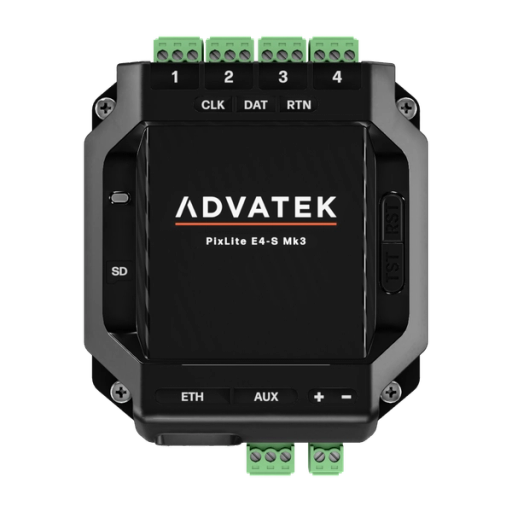
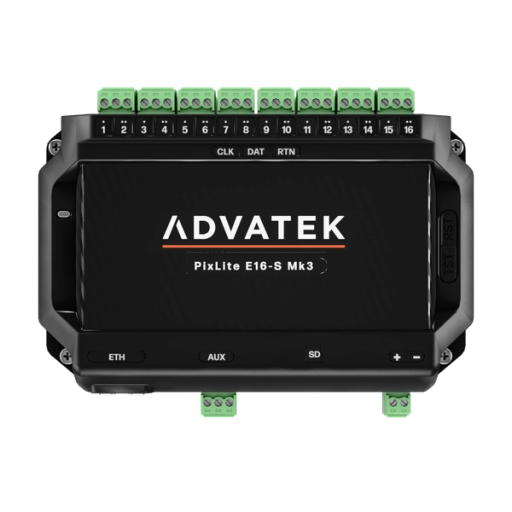
For installations where the controller can be mounted close to the pixels, a controller such as the PixLite® A4-S Mk3, E4-S Mk3 or E16-S Mk3 provides the pixel-ready data directly at the controller.
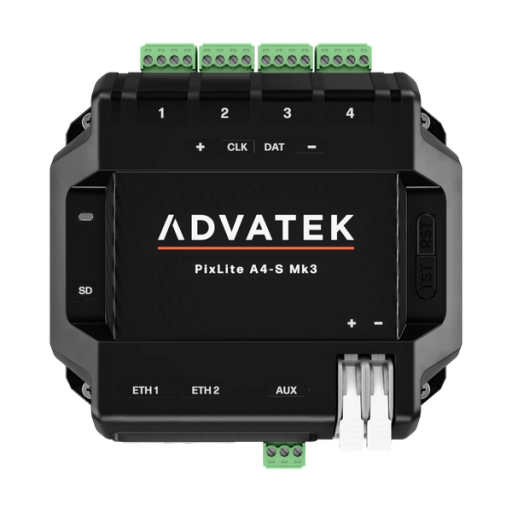
A4-S
Driving up to 24 universes of data, and offering easy mounting, sleek design and electrical fault protection — what’s not to love?
Long range
For a large or distributed installation, it is often better to change the wiring architecture rather than trying to extend the raw single-ended WS2811/WS2812 data signal over a very long cable. The PixLite® T8-S Mk3 long-range controller can send data up to 300 m to R2F-S or R4D-S receivers located closer to the pixels. The R2F-S receiver receives that differential long-distance signal and converts it back into a pixel-ready output locally.
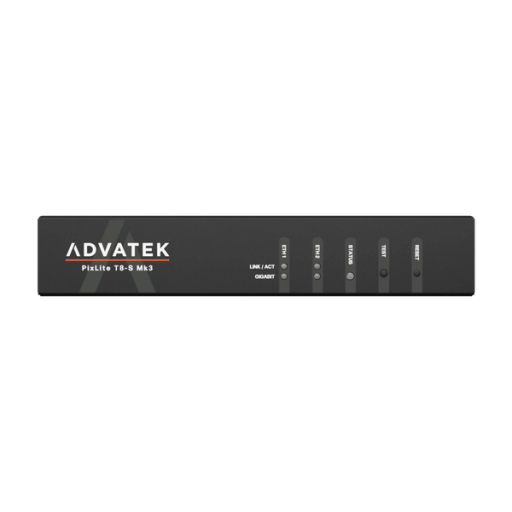
T8-S
With a data transmission range of 300 meters, this user-friendly long range pixel controller system is the high-impact solution for professional installations.
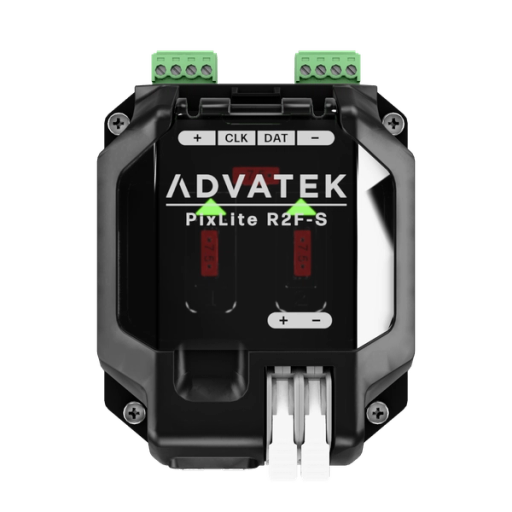
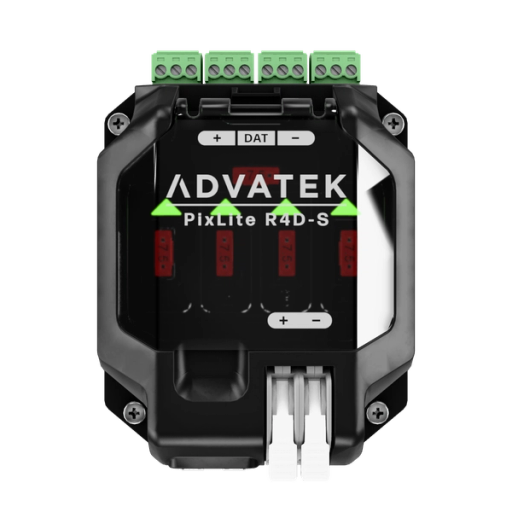
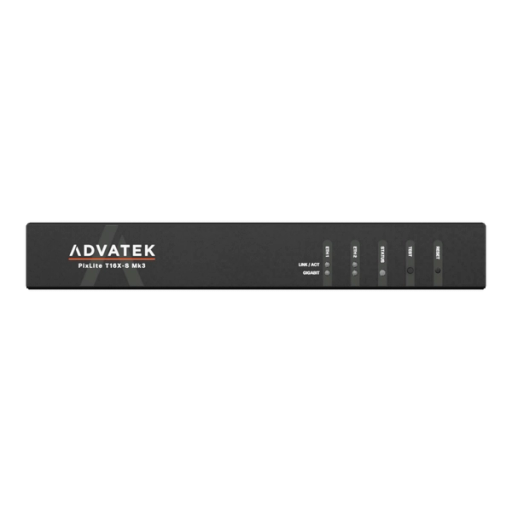
The T16X-S Mk3 provides 16 receiver connections where a greater number of distributed receiver locations is required.
So, which one should you choose?
For a fixture design where flexibility over the LEDs, physical LED placement or a higher-voltage power architecture is important, an external driver such as WS2811 can make sense.
Where the priority is a compact, integrated RGB pixel, WS2812 and WS2812B package the driver and LED together. Between those two, the WS2812B's four-pad construction and reverse-power protection simplify the physical design compared with the original WS2812.
For an entirely new professional installation, however, these three characteristics should only be the beginning of the selection process. Depending on the application, a newer pixel protocol may offer higher color resolution, a higher PWM rate, backup data, faster data transfer, adjustable clocking or Digital Current Control. There is no one-size-fits-all pixel IC: the correct choice depends on what the installation actually needs.
One data wire. Pulse width carries the bit value, and the pixel IC fixes the speed.
FAQs
Can WS2812B replace WS2812?
Can WS2812B replace WS2812?
From a controller-protocol perspective, they are highly compatible: both use an 800 kbps, 24-bit GRB data stream and their timing windows overlap. Their physical packages are different, however, so a WS2812B is not automatically a direct PCB replacement for an original six-pad WS2812.
Is WS2811 the same protocol as WS2812B?
Is WS2811 the same protocol as WS2812B?
No. They share several characteristics, including single-wire signalling, RGB data and commonly an 800 kbps transfer rate, but their driver architecture, protocol revisions, timing and documented channel ordering differ. PixLite® provides separate selections for these protocols.
Are WS2811, WS2812 and WS2812B RGBW?
Are WS2811, WS2812 and WS2812B RGBW?
No. These chips are RGB, using three color channels and 24 bits per 8-bit pixel. RGBW requires a protocol designed for four-channel pixel data.
Which PixLite® Mk3 supports WS2812B?
Which PixLite® Mk3 supports WS2812B?
WS2812B is supported across the PixLite® Mk3 family. Controller selection should instead be based on the number and location of pixel outputs, power requirements and whether a standard-range or long-range architecture is appropriate.
How many WS2812B pixels can a PixLite® control?
How many WS2812B pixels can a PixLite® control?
The answer depends on the PixLite® model, output mode and desired frame rate. Several PixLite® Mk3 direct outputs support up to 1,020 RGB pixels per output, but maximum capacity and desirable operating capacity are not necessarily the same thing. Use the to see how pixel count affects measured output frame rate before finalising the design.